


By: Tyler Q. Kirk, MD
VOLUME 1 | ISSUE 2
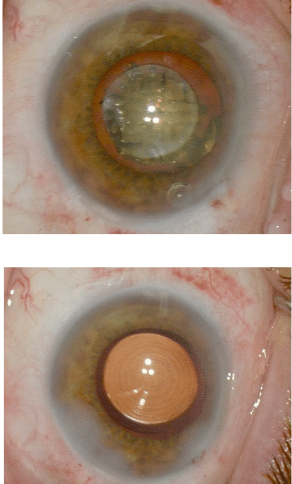
- The centered, perfect sized, capsulotomy is performed in under 1.5 seconds, enhancing safety and effective lens position.
- Iris registration guided corneal relaxing incisions precisely treat astigmatism while accounting for cyclorotation.
- The integrated bed provides a stable position for optimal imaging and treatment.
Femtosecond Laser -Assisted Cataract Surgery (FLACS) Experience:
- After checking into River Forest Surgery Center, your patient will be brought to our preoperative area, the operative eye will be confirmed and dilated, then sublingual midazolam will be administered to reduce any anxieties.
- A technician will help your patient walk to our femtosecond laser room for treatment.
- Your patient is positioned on the laser bed, and the head is secured in position.
- The surgeon confirms the treated eye and surgical plan, with emphasis on checking intended relaxing incisions or toric markings.
- A proparacaine drop is instilled to numb the eye, the liquid interface is then placed, and the vacuum is turned on.
- The patient’s eye is centered under the laser, captured, and docked.
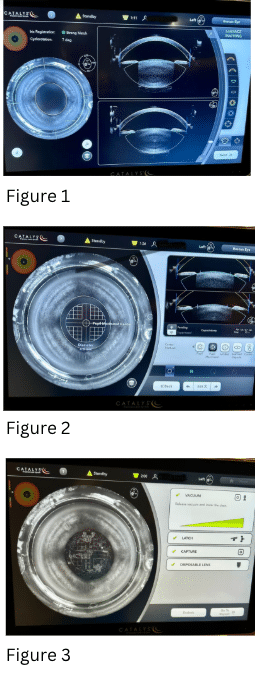
- Catalys 3-dimensional OCT scan fully maps the treatment area and iris registration and cyclorotation recorded (Figure 1).
- Surgeon reviews proposed capsulotomy, lens fragmentation, and corneal incisions (Figure 2).
- Foot pedal initiates laser treatment, which is completed in seconds (Figure 3).
- Patient is undocked, vacuum released, and patient is carefully walked back to the operating suite for the surgeon to remove the cataract and place a new lens implant.
Reasons to Recommend
- Multifocal & EDOF IOLs: Better centration and more predictable effective lens position.
- Astigmatism management: Accounts for cyclorotation, iris registration, more precise toric marks, and relaxing incisions.
- Hypermature/intumescent cataract: Safer capsulotomy; reduces risk of wrap around tear.
- Fuchs dystrophy: Less endothelial cell loss.
- Preexisting macular edema, or macular pucker: Less phaco energy used, and fewer intraocular manipulations yields less inflammation.
- Traumatic or zonular compromised: The more automated surgery places fewer forces on zonules.
- Narrow/closed-angle glaucoma: Tight capsulotomy done perfect, less corneal edema because less energy used.
- Post-refractive: (LASIK, PRK) where patients want to ensure best uncorrected vision.
- Time efficiency: Shorter intraocular surgery for anxious or combative patients, provides better capsule, and faster cataract removal.
- Post vitrectomy: Enhances safety in removing resultant hard nuclear cataract with less energy and quicker recovery.
Who is not a good FLACS candidate?
-Prior RK-incomplete capsulotomy
-Prior filtering bleb-although liquid interface is gentle, we avoid disrupting thin walled cystic blebs.
-Poor dilatation or posterior synechia- unable to have adequate penetrance and capsulotomy
-Anterior chamber cell, hyphema, corneal opacity, or significant corneal edema
Top Ten References:
- Xu, Jia; Li, Wenbo; Xu, Zhe; et al. Comparative visual outcomes of EDOF intraocular lens with FLACS vs conventional phacoemulsification. Journal of Cataract & Refractive Surgery 49(1):p 55-61, January 2023.
- Wörtz G, Gupta PK, Goernert P, et al. Outcomes of femtosecond laser arcuate incisions in the treatment of low corneal astigmatism. Clin Ophthalmol. 2020;14:2229-2236.
- Zhu Y, Chen X, Chen P, Xu W, Shentu X, Yu Y, et al. Lens capsule-related complications of femtosecond laser-assisted capsulotomy versus manual capsulorhexis for white cataracts. J Cataract Refract Surg. 2019;45:337–42.
- Fan, Wei MD; Yan, Hua MD, PhD*; Zhang, Guangbin MD. Femtosecond laser–assisted cataract surgery in Fuchs endothelial corneal dystrophy: Long-term outcomes. Journal of Cataract & Refractive Surgery 44(7):p 864-870, July 2018.
- Chao HW, Cheng CK, Liou SW, Chao HM. Macular pucker and cataract treated with phacoemulsification and IOL implantation combined with small-gauge pars plana vitrectomy: a comparison of outcomes with and without femtosecond laser assistance. Front Med (Lausanne). 2025 May 1;12:1497776.
- Yong Woo Lee, Kyu Seong Cho, Joon Young Hyon, Sang Beom Han. Application of Femtosecond Laser in Challenging Cataract Cases, Asia-Pacific Journal of Ophthalmology, 12(5), 2023: 477-485.
- Samin Hong; Femtosecond Laser-Assisted Cataract Surgery (FLACS) In Angle-Closure Glaucoma. Invest. Ophthalmol. Vis. Sci. 2019;60(9):2053.
- Ahn, H., Jun, I., Seo, K.Y. et al. Femtosecond laser-assisted cataract surgery after corneal refractive surgery. Sci Rep 12, 4263 (2022).
- Song X, Li L, Zhang X, Ma J. Comparing the efficacy and safety between femtosecond laser-assisted cataract surgery and conventional phacoemulsification cataract surgery: systematic review and meta-analysis. Can J Ophthalmol. 2025;60(1):e1-e10.
- Cai, Lei; Ma, Dongmei; Xu, Xujiong et al. Comparative study of FLACS vs conventional phacoemulsification for complex cataracts in vitrectomized eyes. Journal of Cataract & Refractive Surgery 48(12):p 1381-1387, December 2022.
Not Candidate References:
- Trinh T, Solomon B, Mimouni M, et al. Outcomes of femtosecond laser-assisted cataract and refractive lens surgery in patients with prior radial keratotomy. J Cataract Refract Surg. 2022 Apr 1;48(4):449-455.
- Malyugin B. Cataract surgery in small pupils. Indian J Ophthalmol. 2017 Dec;65(12):1323-1328.
- H. Burkhard Dick, Ronald D. Gerste, Suphi Taneri. Femtosecond laser-assisted cataract surgery, Asia-Pacific Journal of Ophthalmology. 14(4),2025.