

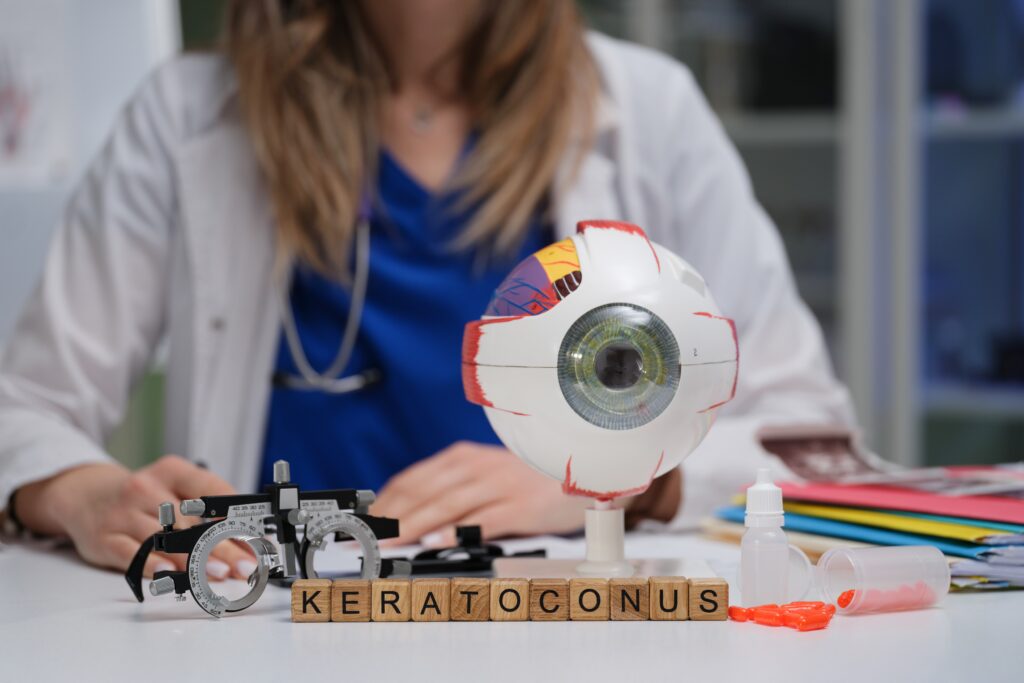
You update your glasses, and within a few months the world looks smeared again. Street signs pick up ghostly double edges, and headlights at night stretch into long streaks. For many people with keratoconus, this frustrating cycle is the first sign that glasses have reached their limit.
Specialty contact lenses are often what finally breaks that cycle. At Kirk Eye Center, our experienced eye care team specializes in fitting custom lenses for patients whose eyes need more than an off-the-shelf solution. Many people who struggled for years are surprised by how clearly they can see once they’re wearing the right lens.
What Is Keratoconus and How Does It Affect Your Vision?

Your cornea is the clear dome at the front of your eye. It does most of the work of bending light so that it lands in focus at the back of the eye.
In a healthy eye, the cornea has a smooth, even curve, but with keratoconus, the cornea slowly thins and begins to bulge forward into a cone shape. The cone is also often lopsided. That uneven curve creates irregular astigmatism, which means light scatters to many different points instead of focusing at one. This is why people with keratoconus often see halos around lights and letters that seem to have shadows. As the cone grows steeper, many people also notice increasing nearsightedness, with distant objects looking blurrier from one eye exam to the next. This is why people with keratoconus often see halos around lights and letters that seem to have shadows.
Can You Wear Regular Contacts with Keratoconus?
In the earliest stages, standard glasses or soft contacts may still give decent vision. As the cone develops, both start to fall short.
Glasses sit about half an inch in front of your eye. They can correct a simple, even prescription, but they can’t make up for the bumps and steep spots on a keratoconus cornea.
Standard soft contacts are flexible, so they drape over the cornea and take on its uneven shape. The lens ends up copying the very irregularity it needs to fix.
Many patients feel like they’ve tried everything without success. In most cases, the lenses they tried were simply never designed for an eye shaped like theirs.
How Do Specialty Contact Lenses Correct Keratoconus?
Most specialty lenses for keratoconus are made from a firm material that holds its own shape. When one sits over your eye, your tears fill the uneven spaces between the back of the lens and the cornea. The smooth front of the lens then becomes the new surface that light passes through. It covers the irregular surface with a smooth one, so light can focus clearly again. For moderate and advanced keratoconus, this is often the only way to get sharp, stable vision without surgery.
What Are the Best Contact Lenses for Keratoconus?
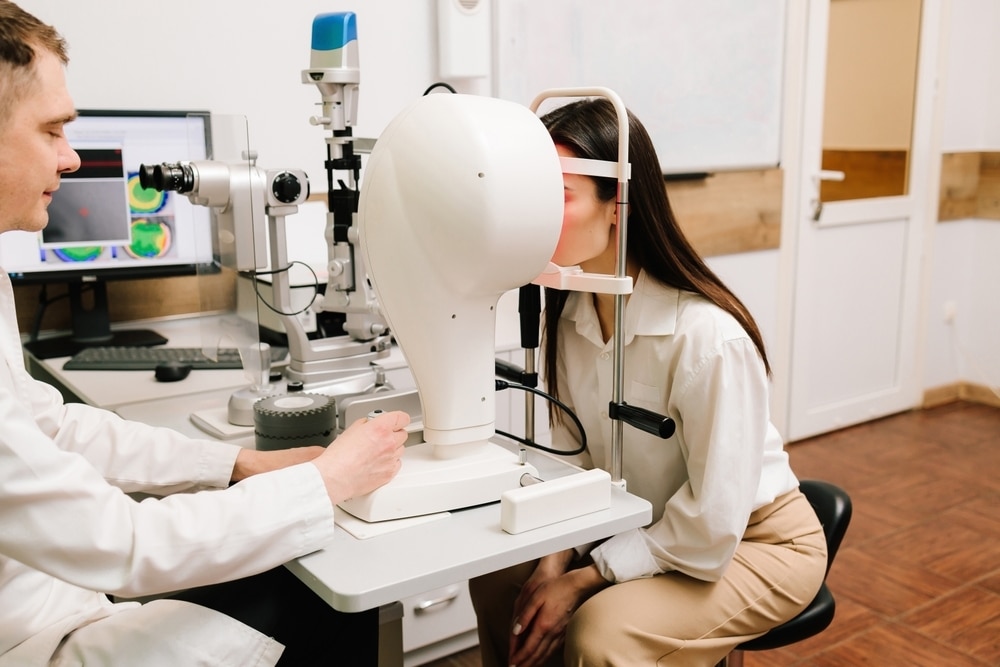
The best lens for you depends on how advanced your keratoconus is, the exact shape of your cornea, and how your eyes handle wearing lenses. Most patients do well with one of the following options.
Rigid Gas Permeable (RGP) Lenses
RGP lenses are small, firm lenses that rest directly on the cornea. They let oxygen pass through to the eye and deliver very crisp vision, which is why they have been a mainstay of keratoconus care for decades. They do take some getting used to, and on a steep cone they may shift when you blink.
Hybrid Contact Lenses
Hybrid lenses combine a firm center with a soft outer ring. The firm center sharpens your vision, while the soft edge helps the lens stay in place and feel more like a regular contact. Many people with mild to moderate keratoconus find hybrids a comfortable middle ground.
Scleral Lenses for Keratoconus
Scleral lenses are larger rigid lenses that arch over the entire cornea and rest on the white of the eye. Because they never touch the cone, they work well even when the cornea is very steep or irregular.
Custom scleral contact lenses also hold a small pool of saline against the eye, which keeps it moist throughout the day. They’re durable too, and a well-cared-for pair typically lasts two to five years.
Are Scleral Lenses Comfortable?
Most people are pleasantly surprised by how comfortable scleral lenses feel once they settle in. The first few days often bring an awareness that something is in your eye, but most patients adjust within a couple of weeks. After that, many wear their lenses 12 to 14 hours a day.
People who also deal with dry eye syndrome often notice an added benefit. Since the saline under a scleral lens bathes the cornea all day, eyes that tend to feel gritty or tired often feel better with the lens in than without it. Inserting and removing the lenses takes some practice, and a small suction tool makes the process much easier.
What Treatment is Available for Patient with Keratoconus?

CTAK (Corneal Tissue Addition Keratoplasty) is a new innovative way to improve vision in patients with keratoconus. By adding in a small amount of donor corneal tissue, we can re-shape the cornea making it more regular. After this procedure, the cornea is more regularly shaped and can allow for improved vision while wearing glasses and contact lenses. Vision without glasses and contact lenses will be about the same. CTAK does not take the place of corneal crosslinking, which should be done in any patient with keratoconus.
Wondering if you are a candidate for CTAK (Corneal Tissue Addition Keratoplasty)? Schedule an appointment at Kirk Eye Center at one of our Chicagoland locations.